Ajay Bohra

Disclosure: We may earn a commission if you open a demat account via links on this page. This does not affect our editorial independence. Read our Affiliate Disclosure.
Last updated: July 2026 · Charges and offers verified against official broker pages where noted.
Waya is a SEBI-registered research analyst platform—not a broker—that pushes stock ideas through separate Equity, F&O, and MCX apps. The pitch is familiar: short-term calls, multibagger baskets, WhatsApp alerts, and one-tap routing to 16 brokers. The friction is also familiar: public reviews still complain about alert delays, support limits, and a separate F&O app with weaker ratings.
This review compares Waya’s 2026 pricing, product split, and recurring user-review themes against Teji Mandi and Univest so you can decide whether a paid advisory subscription fits your process—or whether a portfolio-based alternative makes more sense.
Quick verdict
| Overall | 2.5 / 5 for most retail investors |
|---|---|
| Best for | Experienced traders who already have a broker, want SEBI-labelled research, and can tolerate delayed alerts |
| Skip if | You need real-time alerts, phone support, a free trial, or beginner-friendly hand-holding |
| SEBI RA | INH000010876 (confirm on SEBI intermediary search) |
| App Store rating | 4.1 / 5 on iOS (Jul 2026 listing) |
| Equity subscription | ₹1,299 / quarter or ₹2,499 / year via in-app purchase |
What Waya is (and is not)
Waya Financial Technologies runs multiple advisory apps under one SEBI research-analyst registration. The flagship equity app is Waya – Max your stock earnings; derivatives and commodities are split into Waya FnO and Waya MCX.
Waya does not hold your money or execute trades. You still need a demat account with a broker such as Zerodha, Angel One, or Upstox. Treat every call as research input—not a guaranteed trade ticket.
What Waya gets right
Regulatory label is clear. Waya publishes RA registration INH000010876 and PMS registration INP000008987 on its site, and the equity app lists BSE enlistment No. 5679. That is table stakes, but not every tip channel offers even that.
Product scope is broader than a single feed. Equity calls, multibagger-style baskets, short-trade ideas, sector dashboards, and broker deep-links are all in one subscription lane. FnO and MCX are separated, which is honest product design even if the FnO app’s public ratings lag the main app.
App Store pricing is transparent—even when the website is not. Apple’s listing still shows ₹1,299 for three months and ₹2,499 for twelve months on the equity app. That is easier to verify than scattered “Believer” plan pages on the marketing site.
Broker integrations reduce copy-paste friction. The App Store description claims compatibility with 16 brokers. If you already live inside one of those apps, that workflow matters more than another glossy homepage.
Waya features at a glance
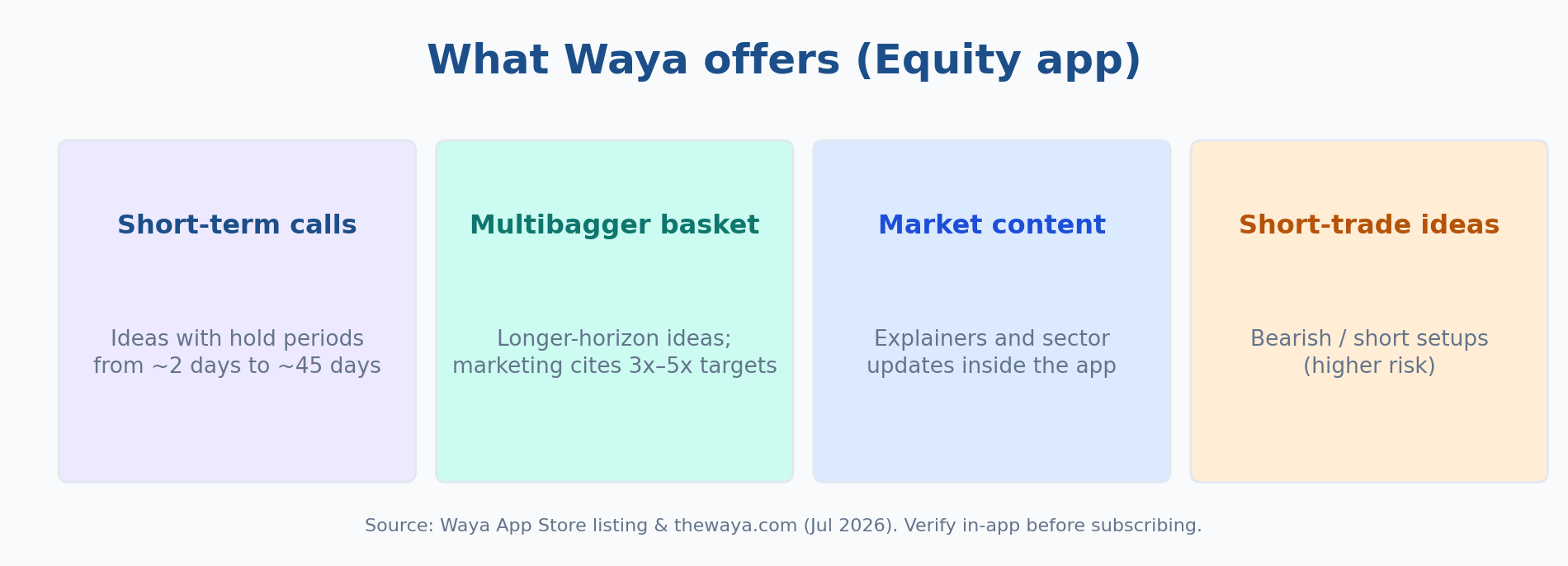
Core services
- Short-term calls: Ideas with stated hold windows (App Store copy cites roughly 2–45 days).
- Multibagger basket: Longer-horizon small/mid-cap themes; marketing cites 3x–5x targets—treat as aspirational, not promised.
- Short-trade lane: Bearish setups; higher risk and not suitable for most beginners.
- Fundamental overlays: Key ratios displayed inside the app for quick context.
Delivery and support
- Push alerts, in-app feed, and WhatsApp notifications (per App Store listing).
- Email support at support@thewaya.com; no published phone desk or live chat.
- iOS and Android apps; FnO and MCX require separate installs.
Where Waya struggles
Public reviews—not lab tests—still cluster around the same failure modes. If your edge depends on entering within minutes of an alert, these themes matter more than feature checklists.
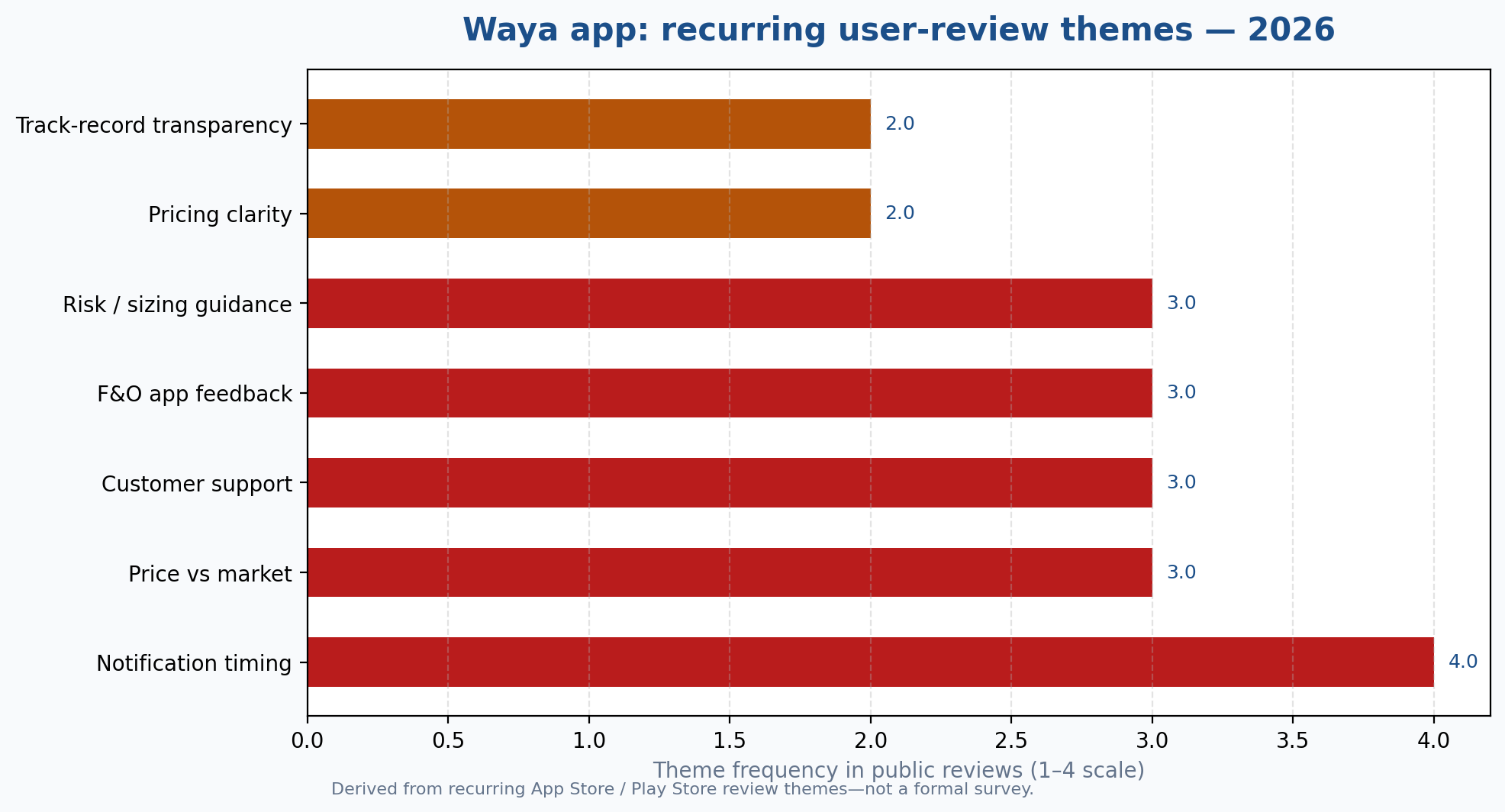
Alert timing
Multiple reviews allege 30–45 minute delays between a published call and the notification landing on their phone. For short-term equity ideas, that gap can erase the stated entry zone before you open your broker app.
Price accuracy and execution
Another common thread: recommended buy ranges no longer match live prices when the alert arrives. That is less about “accuracy” in research terms and more about practical fill rates for subscribers.
Support and the FnO app
Email-only support is a weak fit for a paid real-time product. The separate FnO app also draws sharper negative reviews than the equity app, with users citing losses after following calls. Derivatives are risky even with good research—mixed public feedback raises the bar for due diligence.
Waya pricing in 2026
Waya’s pricing depends on which app and plan you buy. The equity app’s App Store tiers are the easiest to verify; website “Believer” branding adds a premium lane; FnO is priced separately.
| Product | Published price | Notes |
|---|---|---|
| Waya Equity (App Store) | ₹1,299 / quarter · ₹2,499 / year | Auto-renew IAP; check Apple/Google subscription settings |
| Waya Believer (website) | ₹2,500 / quarter · ₹4,500 / year | Marketing plan on thewaya.com |
| Waya FnO | ₹3,500 / month · ₹4,500 / quarter (10% off with code) | Separate app; confirm live price at checkout |
| Waya MCX | From ₹1,000 (site) | Commodity lane; verify before paying |
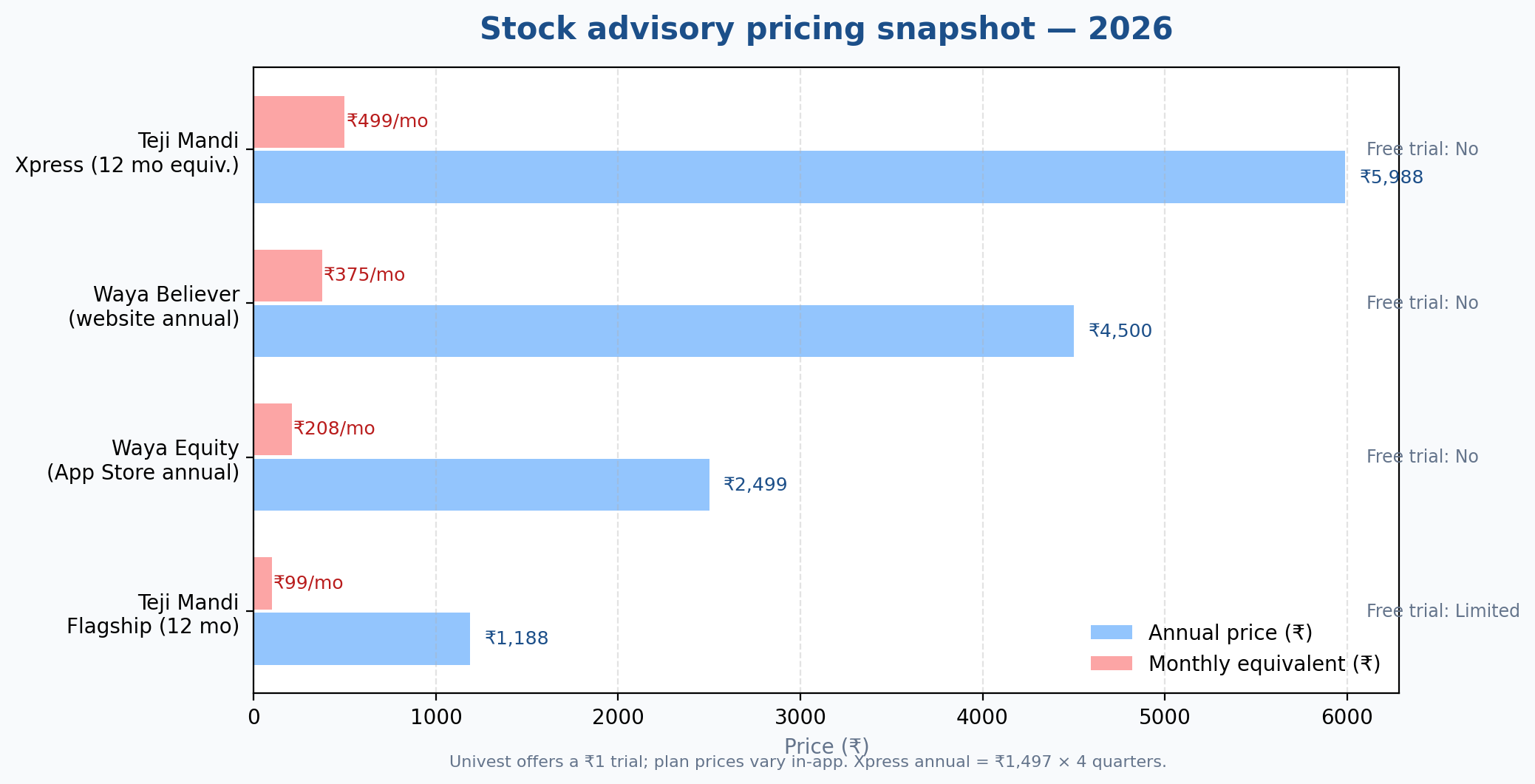
Pricing friction that still shows up in 2026: no extended free trial on the main equity IAP, multiple plan names across site and stores, and FnO priced like a premium terminal product without matching public review scores.
Waya vs Teji Mandi vs Univest
Think of this like picking between two flagships: the spec sheet matters, but so does how you actually use the device day to day. Here the “specs” are registration type, delivery speed, portfolio vs single-call model, and all-in cost.
| Factor | Waya | Teji Mandi | Univest |
|---|---|---|---|
| SEBI status | RA INH000010876 | Registered investment adviser | RA + IA registrations listed on site |
| Model | Stock / basket calls | Curated portfolios + rebalancing | Multi-segment research bundles |
| Entry price | ₹1,299 / quarter (equity IAP) | Flagship from ₹1,188 / year | ₹1 trial, then in-app plans |
| Free trial | No on main equity IAP | Limited / product-dependent | ₹1 trial advertised |
| Support | Phone + app support (per site) | In-app support channels | |
| Best when | You want call-style research with broker routing | You prefer portfolio copy-trading with rebalance rules | You want one app covering equity, F&O, MF lanes |
None of these replace homework. Compare alert latency, track-record disclosure, and how each platform documents losing calls—not just winners.
Who should use Waya—and who should skip it
Skip Waya if
- You are new to markets and need coaching or sizing guidance.
- You rely on instant notifications to enter at published prices.
- You want phone or chat support when a call goes wrong.
- You plan to trade FnO based on a separate app with mixed public reviews.
- You will not pay without a trial period.
Consider Waya only if
- You already have a demat account and a defined risk limit per trade.
- You treat calls as one input and verify prices live before placing orders.
- You specifically want a SEBI-labelled research feed with broker integrations.
- You accept email-only support and the lack of a meaningful free trial.
Final verdict
Rating: 2.5 / 5. Waya checks the regulatory box and packages a full call stack with broker hooks—similar to how a flagship phone checks the spec sheet. But the day-to-day experience users describe in public reviews looks more like laggy notifications, uneven FnO feedback, and support you cannot call when a trade goes sideways.
For most Indian investors—especially beginners—portfolio-led alternatives such as Teji Mandi or trial-friendly apps like Univest are easier to evaluate before you commit real capital. If you still test Waya, size small, log slippage between alert and fill, and never trade FnO until you have verified the current app ratings yourself.